Sunday, 9 March 2014

Lighting diagram and arrangement of lighting for diverse indoors and out door shoots

Shot taken in a studio.

Rim lighting technique was used to accentuate the straight black hair.


The light was positioned just behind the head of the model.


Shot were taken in a studio.

With rim lighting technique also cross light was put at the back side so as to reflect her side features.


There is a strobe pointing to model`s head hidden behind her head and a main fill light which is bounced on an umbrella to produce soft enough light slightly to the side pointing to the model in front.


The effect produced can be seen in this photograph where a small light surrounding the model is seen all around her.


Alice in wonderland photo shoot theme.
Shot were taken outside in a public garden.
 Setup consists of a kick light behind the trees, to add depth to the branches.


 Main fill light and reflector for ambient lighting.


An abstract fashion photo shoot theme done for a fashion TV program.
 Inspired by abstract art.
The session was done to mix 
fashion and abstract art.


Two background lights where positioned behind the model to light up
 the two paintings.


 A kick light was used as hair light and main fill light slightly to the right of the model. Shot were taken in a studio.


Thursday, 6 March 2014

Reference ideas for lighting

As to craft texture on to the set for a photo shoot I thought of way in which texture is not to be dyed or drawn on the background.


In a way to create pattern I plan to use light and its shade & glooms for creating textured patterns.


This are some of the references images so as to design lamps or lighting in a photo shoot.


Also such back lighting will give a evident edge to the model that is standing in front of the light.


Monday, 3 March 2014

“Architectural performance pieces.”


  STABILITY 
(2009)


  • 25 foot structure is a house balanced on a central pivot with the two artists living at either end.
  • When occupied the two bodies will need to move in the space in relation to one another to keep the structure straight.
  • Visually separated by a kitchen and bathroom in the center, the occupying bodies will sense each other through displacement of weight. Activities will naturally change willingly or not as the house shifts.

COUNTERWEIGHT ROOMMATE (2011)


  • Tethered to either end of a single rope, movement in this vertical habitat for two depends on the opposite movement by one's roommate. When one wishes to go up to the kitchen, the other must go down to the bathroom.
  • Counterweight Roommate is a self-contained living unit with facilities for eating, sleeping, and working.

  • It was inhabited day and night for the continuous five days by the artists.

  •  The bathroom, located in the ground floor enclosure
  • Two views in the kitchen, located on the fifth floor, at the top.


 IN ORBIT 
(2014)

Artists Alex Schweder and Ward Shelley have constructed a giant wood hamster wheel with a 25-foot-diameter where the duo are currently living and working for 10 days until March 9 at the Boiler in Williamsburg, Brookyln.
  • For In Orbit, the rotating house is designed so that Shelley can live on the exterior of the wheel nearly 30 ft. off the floor, while Schweder lives on the inside due to a fear of heights.
  •  Through coordinated movements the pair can rotate the wheel to access beds, desks, chairs and even a kitchen-bathroom combo.

  • Everything Shelley and Schweder need, furniture-wise, is fastened to the wheel: bed, desk, kitchen-bathroom combo, comfy chair, lamps, and dresser.
  • Each piece of Shelley's furniture is aligned with its Schweder counterpart. So they both have to work at their desk at the same time, use the bathroom in tandem, they have the same bedtimes, etc. They move the wheel to each station by walking in tandem in opposite directions. 

  • Shelley wears a red jump suit, and Schweder's is orange, because that's what they happened to already own when they started the project. Most of their furniture matches their jumpsuits.


Saturday, 1 March 2014

Final Nottingham night light display

the showcase day


This was my 1st live project work. Doing it with other group of students was very helpful and also got to learn other disciplines from different course of people.
Also during the project got to try my hands over few new software that deal with lighting, even though they were too technical to understand but have got essential idea on to it by now.


During the course of working I realized actually bring into being a live event or project is far more diverse and needs lots of efforts to do it rather than just designing part of it.


To see the finish product as a whole gives a sense of satisfaction and encourages doing more work.

Tuesday, 25 February 2014

Suspended Net Installations


In the late 1990s artist Janet Echelman traveled to India as a Fulbright Scholar with the intention of giving painting exhibitions around the country. She shipped her painting supplies ahead of time and landed in the fishing village of Mahabalipuram to begin her exhibitions with one major hitch: the painting supplies never arrived. While walking through the village Echelman was struck by the quality and variety of nets used by the local fisherman and questioned what it might look like if such nets were hung and illuminated in the air.


It became be a new approach to sculpture. A new chapter in her artist career was born, and the artist has since dedicated her time and energy to creating these massive net sculptures in locations around the world.


Echelman is currently embarking on her largest piece ever, a 700-foot-long sculpture that will be suspended over.

Friday, 21 February 2014

NOTTINGHAM NIGHT LIGHT (PART 3)

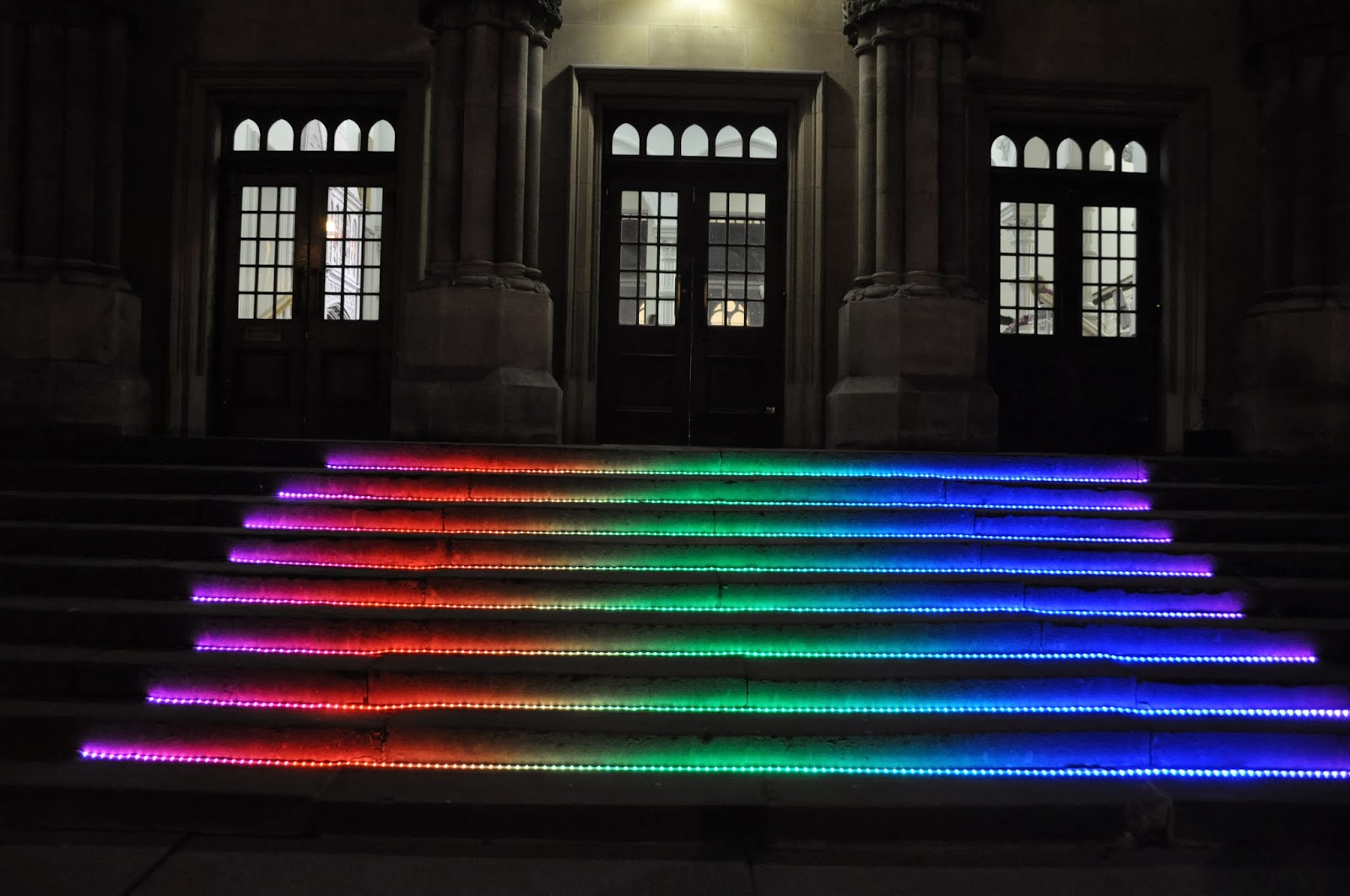
Setting up a trial and connecting and activating all led strips final product 
and programming it on to a software to work an generate patterns accordingly.


Led strips set up with different programming and patterns on advino software.


Tuesday, 18 February 2014

NOTTINGHAM NIGHT LIGHT (PART 2)

The Rainbow is a 1915 novel by British author D. H. Lawrence. It follows three generations of the Brangwen family living in Nottinghamshire,particularly focusing on the individual's struggle to growth and fulfillment within the confining strictures of English social life.
The Rainbow tells the story of three generations of the Brangwen family, a farm/ labouring dynasty who live in the East Midlands of England near Nottingham. The book spans a period of roughly 65 years from the 1840s to 1905, and shows how the love relationships of the Brangwens change against the backdrop of the increasing industrialization of Britain. The first central character, Tom Brangwen, is a laborer whose experience of the world does not stretch beyond Nottinghamshire; while the last, Ursula, his granddaughter, studies at University and becomes a teacher in the progressively urbanized, capitalist and industrial world that would become our modern experience.
The book starts with a description of the Brangwen dynasty, and then deals with how Tom Brangwen, one of several brothers, fell in love with a Polish refugee, Lydia. The next part of the book deals with Lydia's daughter by her first husband, Anna, and her destructive, battle-riven relationship with her husband, Will, the son of one of Tom's brothers. The last and most extended part of the book, and also probably the most famous, then deals with Will and Anna's daughter, Ursula, and her struggle to find fulfilment for her passionate, spiritual and sensual nature against the confines of the increasingly materialist and conformist society around her. She experiences a lesbian relationship with a teacher and a passionate but ultimately doomed love affair with Anton Skrebensky, a British soldier of Polish ancestry. At the end of the book, having failed to find her fulfilment in Skrebensky, she has a vision of a rainbow towering over the Earth, promising a new dawn for humanity:

"She saw in the rainbow the earth's new architecture, the old, brittle corruption of houses and factories swept away, the world built up in a living fabric of Truth, fitting to the over-arching heaven."

it was to be of relevance to this novel THE RAINBOW by D.H. Lawrence.


Due to some safety measures and cost concern the proposal of lighting shifted from arch on to the steps.


And whereby we started thinking about alternative options to be created on to the steps. With ma students for interactive design course also were part of this event, so with light we also had an idea to combine some playing features like changing of light patterns by walking or by sound.